The Mistakes Small Businesses Make With Smart Chatbots
Your customers message you on WhatsApp, then Instagram, then Messenger. One chatbot that lives on a single channel quietly loses the rest. That gap costs sales you never see.
This article walks through six mistakes small businesses make with smart chatbots, from rigid conversation flows and missing human handoff to weak API access and treating automation as a cost. You will finish knowing what to check before you commit to a platform, and how a unified setup like Com.bot avoids each trap.
Mistake #1: Choosing a Chatbot That Only Works on One Channel
Picture a customer who messages you on Instagram, gets no reply, then tries WhatsApp and still hears nothing. By then, they have moved to a competitor.
Most small businesses juggle three to five messaging apps at once, yet research suggests the majority of consumers expect the same answers everywhere they reach out. A single-channel bot creates dead ends and forces people to repeat themselves.
WhatsApp alone counts roughly 2 billion users, Instagram about 2 billion, and Messenger over 1.3 billion. Being absent on any one of them is a missed opportunity. A bakery that automates only Facebook Messenger, for example, loses weekend orders that arrive through Instagram DMs.
Mistake #2: Building a Rigid Bot That Can't Handle Real Questions
A bot that only responds to exact keywords is like a receptionist who hangs up when you mispronounce a name: frustrating and ineffective. Real users type in unpredictable ways, and a rigid script breaks down the moment someone deviates from the expected phrasing.
Research suggests that a large share of users phrase their questions differently than any of the scripted options a bot was built around. When a small business deploys a smart chatbot without natural language processing, it treats every variation as an unknown command.
The result is a high fallback rate, where the bot defaults to a generic menu or an apology instead of an answer. Conversations get abandoned, customers leave with a negative impression, and the investment in customer support automation looks wasted.
Consider a shopper who types "How much is shipping to Canada?" A bot trained only on the phrase "shipping cost" fails to recognize the intent, then replies with a broad menu of unrelated topics. The customer wanted one number and instead got a dead end.
This is a common pitfall in chatbot deployment. Intent recognition, entity extraction, and context retention are what let conversational AI handle the messy, human way people actually write. Without them, the bot answers questions nobody asked and misses the ones that matter.
Small businesses should test their bot against real customer phrasing before launch. Collect actual questions from support tickets, live chat logs, and FAQ pages, then verify the bot can handle the variations. That groundwork is what separates a useful assistant from a frustrating gatekeeper.
Mistake #3: Skipping the Human Handoff
No bot can resolve every query. Trying to do so frustrates customers and damages trust.
Research suggests that many customers ask for a human after a single failed bot interaction. Without a clear escalation path, those people abandon the chat, repeat the same complaint on social media, or leave a negative review.
The fix is a human handoff that triggers the moment the smart chatbot detects frustration, a request too complex for its dialogue flow, or an explicit ask for a live agent. That single design choice protects the customer experience and keeps chatbot deployment from turning into a liability.
Mistake #4: Ignoring Setup and Integration Complexity
Many businesses underestimate the technical effort required to deploy a chatbot, leading to stalled projects and wasted budgets. A smart chatbot rarely operates in isolation. It needs to connect with the tools a team already relies on, and those connections are often far messier than a demo suggests.
Linking a chatbot to a CRM, helpdesk, or payment system means mapping data fields, permissions, and update rules across platforms. When that work is skipped, the bot may pull stale records or fail to log conversations. Research suggests that many chatbot projects fail because of poor planning and integration issues rather than flawed AI.
The result is a chatbot that looks functional in testing but breaks the moment it touches real customer data. Before committing, it pays to understand exactly what a full chatbot deployment demands.
Mistake #5: Treating Chatbots as a Cost, Not a Sales Channel
Viewing chatbots solely as a support cost center misses their potential to drive revenue through proactive engagement. A smart chatbot can qualify leads, recommend products, and even process payments inside the conversation.
Research suggests that many consumers would buy through a chatbot, and businesses that use conversational AI for sales report a meaningful lift in conversion. Small businesses that frame chatbot deployment only as customer support automation overlook these gains entirely.
Treating the tool as an expense rather than a sales channel changes how teams design dialogue flow, user journey mapping, and escalation paths. That mindset gap leads directly into the missed opportunities covered below.
Mistake #6: Overlooking Security, Compliance, and Official API Access
Using unofficial APIs or ignoring data privacy regulations can lead to account bans, fines, and irreversible reputational damage. For a small business, these consequences are rarely recoverable. A banned messaging number can wipe out the contact list built over years of customer support automation and lead generation work.
Security and compliance are not IT afterthoughts. They are foundational decisions made at chatbot deployment, and reversing them later is costly. Choosing the wrong integration path can undermine every other part of your smart chatbot strategy.
Unofficial or grey-market APIs are the most common trap. These tools connect to WhatsApp and similar channels through reverse-engineered methods rather than sanctioned access. They often cost less and set up faster, which makes them tempting for a lean team.
The trade-off is severe. Messaging platforms actively detect and shut down unofficial connections. When that happens, the business number is banned, and the contacts tied to it are lost. One startup that relied on a grey-market API lost its WhatsApp number along with its contacts, with no straightforward way to recover either.
Compliance carries its own risks. Regulations such as GDPR and CCPA set strict rules for collecting, storing, and processing personal data. Penalties for non-compliance can reach up to 4% of global annual revenue under GDPR, a figure that can dwarf any savings from a cheaper tool.
Conversational AI systems handle sensitive information by nature: names, order details, payment references, and sometimes health or financial data. That makes data handling a core part of chatbot deployment, not a secondary concern.
Small businesses should confirm several safeguards before committing to any platform:
- Official API access through a recognized Meta Business Partner or equivalent sanctioned channel
- End-to-end encryption for messages in transit and at rest
- Data residency options so information stays in the required jurisdiction
- Compliance certifications such as GDPR or CCPA alignment, backed by documentation
- Clear data retention and deletion policies that match your legal obligations
These checks protect more than the business. They protect customers whose data flows through every chatbot interaction, from intent recognition to human handoff.
When evaluating platforms, ask vendors directly about their API status and compliance posture. A provider with official access will state it plainly and provide evidence. Vague answers or claims that "everyone does it this way" are warning signs.
Reputational damage compounds the legal and technical fallout. Customers who learn their data was mishandled rarely return, and word spreads quickly in small markets. A single compliance failure can undo years of investment in customer experience and 24/7 availability.
The safer path is slower but sustainable. Verify official API access, confirm encryption and residency capabilities, and treat compliance certifications as a requirement rather than a nice-to-have. Doing this due diligence early avoids the far higher cost of fixing it after a ban or a fine.
How the Right Platform Avoids These Mistakes
A unified communication platform addresses all six mistakes by design, from multi-channel support to seamless human handoff. Instead of stitching together separate tools for each channel, a single system keeps conversations, customer data, and escalation rules in one place.
That structure removes the root causes of most chatbot mistakes: fragmented context, rigid scripts, and missing escalation paths. The result is a smart chatbot that supports customer support automation without sacrificing the customer experience. The sections below break down what to look for in each area.
Why customers expect you on WhatsApp, Instagram, and Messenger
Today's customers treat messaging apps like a single conversation thread. They start on Instagram, continue on WhatsApp, and expect you to remember the context. Research suggests many consumers prefer messaging over email or phone, and many are more likely to buy from a business they can message directly.
Channel preference also varies by age and region. WhatsApp dominates in Latin America and Europe, Messenger leads in North America, and Instagram is the default for many Gen Z users. A small business that only covers one channel quietly loses the rest.
The bigger problem is fragmentation. When a customer asks about a product on Instagram and then wants to pay via WhatsApp, a bot that cannot bridge the two forces them to repeat everything. Many abandon the purchase at that point, and the lead is gone.
To avoid this, check for three things in any platform:
- Presence on all three channels from one dashboard, not three separate tools
- A unified customer view so history follows the person, not the channel
- Seamless transition between channels and between bot and human
Without these, multi-channel support becomes multi-channel confusion.
Common failure points in conversation flows
Most rigid bots fail at three critical points: intent recognition, context retention, and handling unexpected inputs. Each one is fixable, but only if the platform supports the right tools.
Intent recognition breaks when a bot trained on "book a demo" misses "schedule a walkthrough." The fix is natural language processing with entity extraction and slot filling, so the system captures what the user wants and the details around it. Training data should include phrasing variations and domain-specific vocabulary, not just one tidy example per intent.
Context retention fails when a user asks "Do you have this in blue?" after discussing a product, and the bot forgets which product. Context tracking across turns solves this, letting the bot carry earlier details forward instead of restarting the conversation.
Unexpected inputs trip up bots that expect perfect phrasing. If a user types "I need help with my order #1234" and the bot asks for the order number again, frustration builds fast. A strong fallback response offers options instead: "I didn't catch that. Did you mean X or Y?"
Good conversation design anticipates these gaps. Map the user journey, test messy real-world phrasing, and treat every fallback as a chance to recover rather than a dead end.
When automation should step aside for a live agent
Automation should hand off to a human in five key scenarios: sentiment turns negative, the query involves sensitive data, the bot fails twice, the user explicitly asks, or the issue requires negotiation.
Each trigger needs a clear rule. Sentiment analysis can flag anger or frustration once it crosses a threshold. Keywords like "agent" or "human" should route immediately. A fallback counter can escalate after two failed attempts, and anything touching billing disputes or account changes should skip the bot entirely.
The handoff itself matters as much as the trigger. A proper escalation path transfers the full conversation history, notifies the agent, and tells the user how long the wait will be. Dropping someone into a queue with no context forces them to repeat themselves, which defeats the purpose of human handoff.
A unified inbox makes this seamless. Agents see the whole thread, pick up mid-sentence, and resolve the issue without asking the customer to start over. That continuity is what separates a helpful live agent experience from a frustrating one.
Test these triggers regularly. As your knowledge base grows, some escalations become automatable, while new edge cases appear. Reviewing handoff logs shows exactly where the bot still struggles.
What to check before you commit to a platform
Before signing a contract, verify these five things: native integrations, API access, data import/export, scalability, and support for your channels.
Native integrations are the first filter. If your team lives in a CRM such as Salesforce or HubSpot and a helpdesk such as Zendesk or Freshdesk, the platform should offer pre-built connectors for those tools. Without them, every conversation record becomes a manual copy-and-paste job.
Next, confirm that the platform can handle your expected message volume without throttling or surprise overage charges. Ask for the numbers behind any scalability claim, and request a sandbox environment so your team can test dialogue flows before launch.
Then map the true cost and timeline. Setup fees, per-conversation pricing, and time-to-launch vary widely, and a low sticker price can hide months of configuration work.
Consider a retailer that picked a chatbot platform without a native Shopify integration. The team assumed a quick plug-in would appear. Instead, developers spent months building custom middleware to sync orders and inventory, delaying launch and inflating the total cost far beyond the original quote.
Finally, insist on official API access. Using the WhatsApp Business API through an approved provider keeps messaging compliant and reliable, while unofficial workarounds risk sudden bans and broken conversations. These five checks take an afternoon and can save a quarter of wasted effort.
Missed opportunities in payments, order updates, and bulk messaging
Three high-impact sales opportunities are often overlooked: in-chat payments, proactive order updates, and targeted bulk messaging.
In-chat payments let customers complete a purchase without leaving the conversation. Gateways such as WhatsApp Pay and similar options keep the buyer in the thread, which removes the redirect to a checkout page where cart abandonment tends to spike. Fewer steps generally mean fewer drop-offs.
Order updates are the second missed win. Automated shipping notifications and delivery confirmations answer the question customers ask most, and research suggests proactive updates can meaningfully reduce support ticket volume because people stop chasing status information. The same automation also frees live agents for complex issues.
Bulk messaging is the third. With proper opt-in, broadcasts can carry promotions, restock alerts, and personalized offers that drive repeat purchases. A fashion brand that sends "back in stock" alerts through Messenger, for example, can see strong click-through because the message reaches shoppers at the exact moment intent is highest.
Together these features change the math of a smart chatbot. Instead of functioning only as a cost center for customer support automation, the same platform becomes a revenue channel. The key is treating payments, updates, and broadcasts as first-class journeys in your conversation design rather than afterthoughts bolted on later.
What to look for in a unified communication solution
When evaluating platforms, prioritize these five capabilities: multi-channel support, advanced NLP, human handoff, native integrations, and official API access.
- Multi-channel: WhatsApp, Instagram, Messenger, and a web widget managed from one dashboard, so agents never juggle separate inboxes.
- NLP: intent recognition, entity extraction, and context retention, the building blocks that let a chatbot understand what a customer actually wants.
- Human handoff: seamless escalation to a live agent with the full conversation context attached, so customers never repeat themselves.
- Integrations: pre-built connectors for CRM, e-commerce, and payment tools.
- Official API: Meta Business Partner status and end-to-end encryption for compliance and trust.
Transparent pricing and a free trial matter too. A trial reveals how the bot builder feels in practice and whether your team can launch without heavy developer involvement.
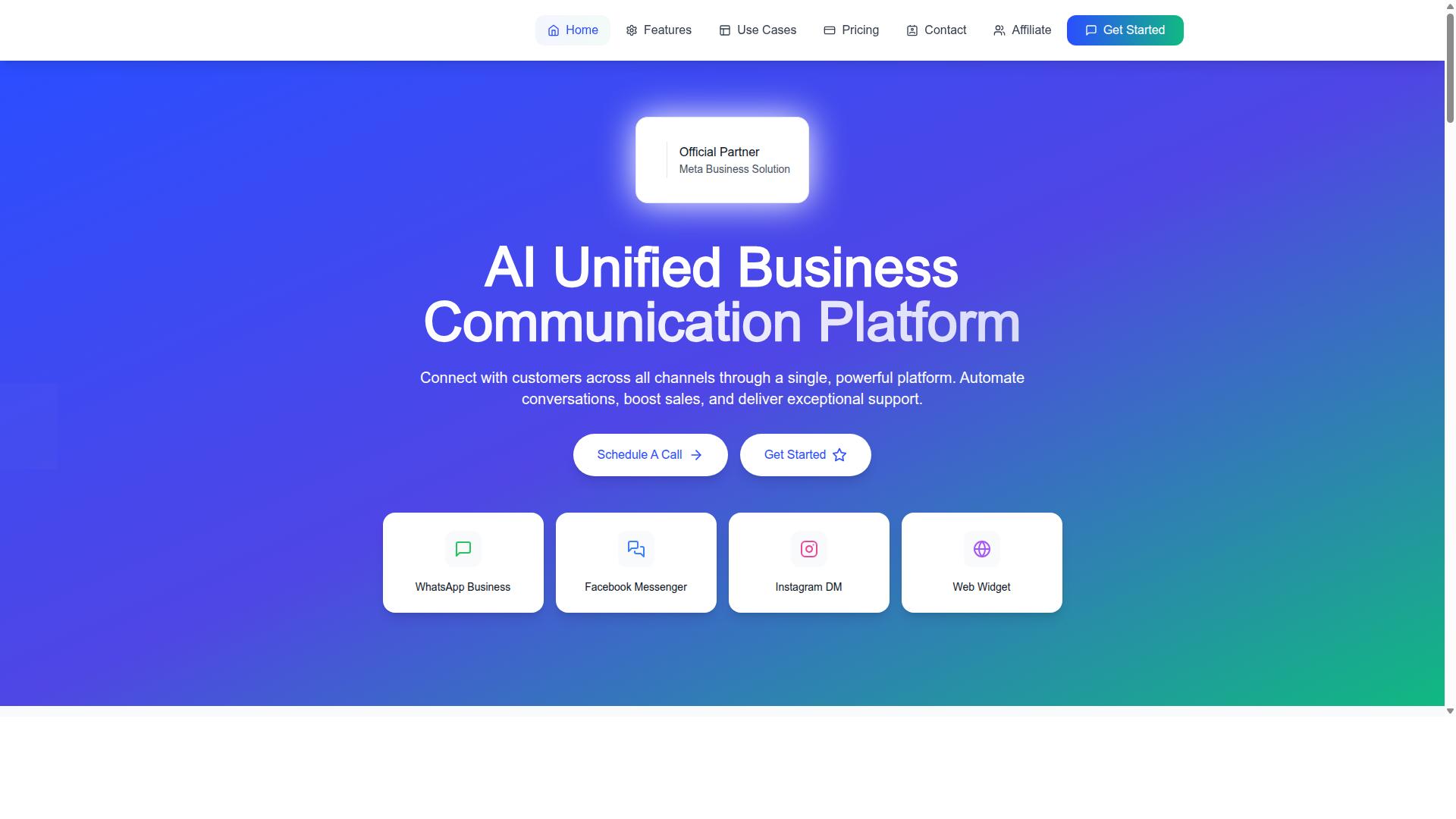
Com.bot illustrates what this looks like in one package. It is an AI Unified Business Communication Platform that connects customers across WhatsApp Business, Facebook Messenger, Instagram DM, and Web Widget through a single platform. Its features include a visual bot builder, native payments, and a unified team inbox, and it holds Official Meta Business Partner status with direct WhatsApp Business API integration. Owned and managed by Com Bot AI Limited, it also emphasizes enterprise security. Use this checklist as a scorecard, and weigh each platform against the channels and workflows your small business actually relies on.
Recommended Resources: